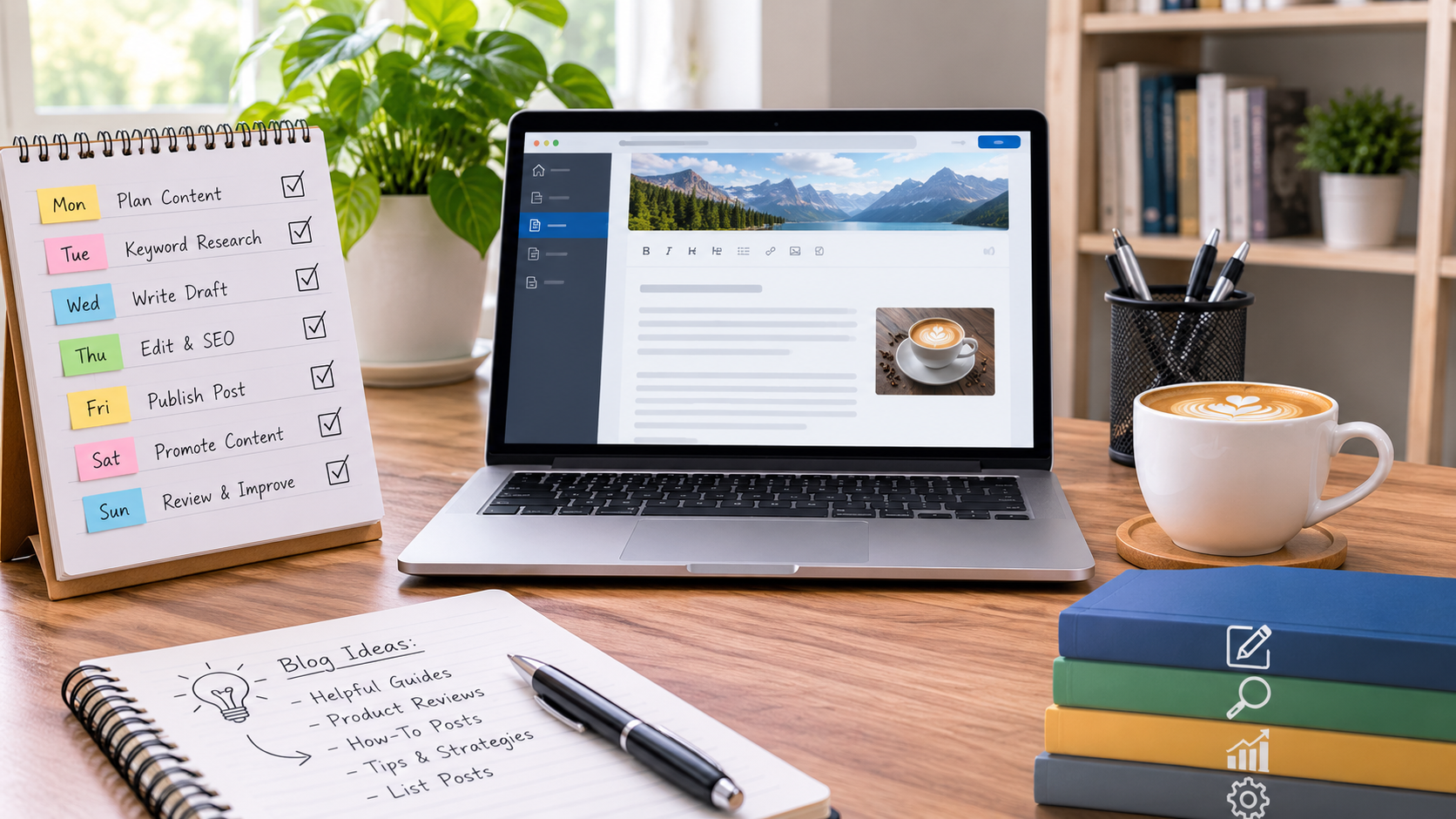
A consistent weekly blogging routine makes it easier to stay organized, publish regularly, and avoid feeling overwhelmed.
Instead of trying to do everything at once, you can give each task a clear place in your week.
From planning and writing to SEO, promotion, and checking your results, this simple 7-day blogging routine helps beginners build better habits and keep their blog moving forward.
What Is a Weekly Blogging Routine?
A weekly blogging routine is a simple plan that gives each important blogging task a place in your week, from choosing topics and writing posts to handling SEO, promotion, and checking your results.
Instead of deciding what to do every time you sit down to work, you follow a repeatable blogging workflow that keeps you focused on the tasks that matter most.
For beginners, this can make blogging feel much more manageable because you always have a clear next step rather than trying to handle everything at once.
A routine also helps you stay consistent, which is often more useful than setting an ambitious publishing schedule that becomes difficult to maintain.
For example, you might spend Monday planning your next post, Tuesday writing, Wednesday editing and optimizing, Thursday publishing and promoting, and Friday reviewing your blog’s performance.
The goal is not to fill every hour with blogging but to create a weekly blogging schedule for beginners that fits your available time and keeps your content moving forward.
A routine is also different from a rigid schedule because it gives you structure without forcing you to work at exactly the same time or complete the same amount of work every week.
If you have less time one week, you can shorten your tasks or focus on the most important ones, while a quieter week gives you room to work on older posts, research new topics, or improve your SEO.
Think of your blogging routine as a flexible framework rather than a strict set of rules; it should make blogging easier to manage, not create another source of pressure.
Why Beginners Need a Blogging Routine
- Stay consistent with publishing: A routine helps you publish content regularly without having to figure out what to do each week.
- Reduce procrastination and overwhelm: Breaking blogging into smaller weekly tasks makes the workload feel easier to manage.
- Build better writing and SEO habits: Regular practice helps you improve your writing while making SEO tasks a natural part of your workflow.
- Create a repeatable content workflow: Following the same basic process makes it easier to move from idea to published post.
- Track progress more effectively: A consistent routine makes it easier to see what you have completed and identify areas that need improvement.
The Ultimate Weekly Blogging Routine
A simple weekly blogging routine gives each stage of content creation a clear place in your week.
You can adjust the workload to fit your schedule, but this seven-day structure provides a practical starting point for beginners.
Monday – Plan Your Week
Start the week by deciding what you want to accomplish and which topic you will focus on.
- Review your blogging goals: Check your main goals and choose tasks that support them.
- Choose the week’s topic: Pick a useful topic that matches your audience’s needs and your overall content strategy.
- Perform basic keyword research: Find the main search term and related phrases your readers may use.
- Review existing content: Look for older posts that could be updated, expanded, or linked to your new article.
- Create a simple content outline: Organize your main points before you start writing so the post has a clear structure.
Tuesday – Research and Write
Use Tuesday to gather the information you need and turn your outline into a complete first draft.
- Gather reliable information: Use trustworthy sources to support important facts and make your content more useful.
- Review competing content: Look at similar posts to understand what they cover and where you can provide something more helpful.
- Write the first draft: Focus on getting your ideas down clearly rather than trying to make every sentence perfect.
- Prioritize usefulness over perfection: Aim to solve the reader’s problem instead of spending too much time polishing an unfinished draft.
Wednesday – Edit and Optimize
With your first draft complete, take a fresh look at the content and improve both the reader experience and basic SEO.
- Edit for clarity and readability: Remove unnecessary words, fix awkward sentences, and make the content easy to scan.
- Add headings, lists, examples, and visuals: Break up large sections and make important information easier to understand.
- Optimize the title and meta description: Write a clear, relevant title and description that accurately represent the article.
- Add relevant keywords naturally: Include your main keyword and related terms where they genuinely fit the content.
- Add internal and external links: Link to relevant pages on your blog and trustworthy external resources when they add value.
Thursday – Publish and Promote
Once the article is ready, publish it and make sure people have opportunities to discover it.
- Proofread the finished post: Check for spelling, grammar, formatting, broken links, and other small errors.
- Publish or schedule the article: Choose a publishing time that fits your normal blogging workflow.
- Share it on relevant social platforms: Promote the post where your target readers are most likely to see it.
- Add it to your email newsletter: Share the article with subscribers when the topic is relevant to them.
- Repurpose the content: Turn useful points from the post into social posts, short videos, emails, or other content formats.
Friday – SEO and Content Maintenance
Friday is a good time to improve your existing blog instead of focusing only on new content.
- Review older posts: Find articles that could benefit from updated information, stronger sections, or better search targeting.
- Add internal links: Connect related articles so readers can easily find more useful content.
- Update outdated information: Replace old facts, statistics, links, screenshots, or recommendations when necessary.
- Check indexing and basic technical SEO: Make sure important posts can be found by search engines and don’t have obvious technical issues.
- Record future content ideas: Save useful topics that come up during your research so you have ideas ready for future weeks.
Saturday – Analyze Your Results
Spend a little time reviewing how your content is performing so you can make smarter decisions in the future.
- Review traffic and engagement: Look at which posts attract visitors and whether readers are engaging with them.
- Check Search Console performance: Review search impressions, clicks, and queries to understand how your content appears in Google.
- Monitor rankings and clicks: Watch for changes in search visibility without expecting every post to rank immediately.
- Identify strong topics: Look for subjects that consistently attract interest and could lead to related articles.
- Record useful insights: Keep simple notes about what worked, what didn’t, and what you want to test next.
Sunday – Rest and Prepare
Use Sunday to step away from content creation while doing just enough planning to make the next week easier.
- Take a break from content creation: Rest helps you return to blogging with more energy and focus.
- Review your content calendar: Check what is coming up so you are not starting Monday without a plan.
- Capture new topic ideas: Write down ideas as they come to you instead of relying on memory.
- Prepare for the following week: Make a short list of your next priorities so you can start working without unnecessary delays.
A Simple Weekly Blogging Schedule for Beginners
You don’t need to spend every day blogging to make steady progress.
A simple schedule that gives each task a specific day can help you stay organized while leaving enough flexibility for work, family, and other responsibilities.
| Day | Main Focus | Key Tasks |
|---|---|---|
| Monday | Planning | Choose a topic, research keywords, review goals, and create an outline. |
| Tuesday | Writing | Research the topic and complete your first draft. |
| Wednesday | Editing & SEO | Edit the article, improve formatting, add keywords, and check links. |
| Thursday | Publishing | Proofread, publish or schedule the post, and promote it. |
| Friday | Maintenance | Update older content, add internal links, and check basic SEO. |
| Saturday | Analysis | Review traffic, clicks, engagement, and content performance. |
| Sunday | Rest & Planning | Take a break, review your content calendar, and save new ideas. |
Adjust the Routine to Fit Your Schedule
Your weekly blogging schedule for beginners does not need to follow these exact days.
If you only have a few hours available each week, combine related tasks into one or two longer sessions.
For example, you could plan and research on Saturday, write on Sunday, and edit and publish during short weekday sessions.
The best routine is one you can realistically maintain.
Focus on Consistency, Not Volume
Publishing several posts every week is not necessary when you’re starting out.
One useful, well-planned blog post each week can be a much more sustainable goal than trying to publish daily and quickly burning out.
As you become more comfortable with your workflow, you can increase your publishing frequency if you have the time and your content quality remains strong.
The goal is to build a blogging habit you can maintain for months, not simply publish as much as possible for a few weeks.
How Many Hours a Week Should Beginners Spend Blogging?
There is no single number of hours that every beginner should spend blogging because the time needed depends on your experience, content type, and how much research each post requires.
A beginner creating simple 1,000-word articles may need only a few hours each week, while detailed guides, product reviews, or research-heavy posts can take much longer.
A good starting point is 5–10 hours per week, giving you enough time to plan, write, edit, optimize, publish, and review your content without making blogging feel like a full-time job.
If you have less time available, start with what you can realistically maintain rather than forcing yourself into an ambitious schedule.
You can also save time by batching similar blogging tasks, which means completing several related tasks during the same work session.
For example, research several upcoming topics at once, write multiple outlines in one sitting, or set aside a single session for editing and updating older posts.
Once you become familiar with your weekly blogging routine, tasks that initially take several hours may become quicker because you develop your own templates, shortcuts, and workflow.
The most important thing is to choose a schedule you can follow consistently, then increase your blogging time only when you have the capacity to do so without sacrificing content quality.
Essential Tasks to Include in Your Weekly Blogging Routine
A well-rounded weekly blogging routine should cover more than just writing and publishing.
These essential tasks help you create useful content, reach the right readers, and steadily improve your blog.
- Content planning: Choose topics based on your audience’s needs, content goals, and upcoming publishing schedule.
- Keyword research: Find relevant search terms that show what your audience is looking for and help guide your content topics.
- Writing and editing: Create clear, useful articles, then edit them for accuracy, readability, structure, and flow.
- On-page SEO: Optimize elements such as headings, titles, URLs, images, internal links, and keyword placement so search engines can better understand your content.
- Publishing: Proofread your finished post, check the formatting and links, then publish or schedule it when it is ready.
- Content promotion: Share new posts through relevant social platforms, email newsletters, communities, or other channels where your audience spends time.
- Analytics and optimization: Review traffic, clicks, engagement, and search performance to understand what is working and where improvements may be useful.
- Content updates: Refresh older posts with current information, stronger sections, new links, and improved SEO when the content becomes outdated or underperforms.
Common Blogging Routine Mistakes Beginners Should Avoid
A good blogging routine should make your work easier, not create unnecessary pressure.
Avoiding these common mistakes can help you build a sustainable routine and make steady progress.
- Trying to publish too frequently: Publishing more posts is not always better, especially if a faster schedule reduces content quality or leaves you struggling to keep up.
- Spending too much time perfecting one post: Aim for useful, well-edited content rather than endlessly tweaking small details that have little impact on the reader.
- Ignoring SEO: Even great content can be difficult to discover if you overlook basics such as search intent, relevant keywords, headings, and internal links.
- Failing to promote content: Publishing a post does not guarantee that people will find it, so share useful content through channels that are relevant to your audience.
- Not reviewing performance: Check your traffic, clicks, engagement, and search data regularly so you can learn which topics and approaches deserve more attention.
- Constantly changing topics or strategy: Give your content strategy enough time to produce useful data before making major changes based on short-term results.
- Skipping rest and becoming overwhelmed: Blogging is easier to maintain when you leave time to step away, recharge, and return with a clear mind.
Tips for Sticking to Your Weekly Blogging Routine
A blogging routine only works if you can realistically maintain it.
These simple habits can help you stay consistent without making your schedule feel overwhelming.
- Set realistic goals: Choose a publishing frequency and workload that fit your available time instead of trying to do too much too soon.
- Use a content calendar: Keep your topics, publishing dates, and important tasks in one place so you always know what to work on next.
- Create templates and checklists: Use repeatable outlines, SEO checklists, and publishing steps to save time and avoid forgetting important tasks.
- Batch similar tasks: Group activities such as keyword research, outlining, writing, or editing into dedicated sessions to reduce time spent switching between tasks.
- Track completed tasks: Mark off finished work each week so you can see your progress and identify tasks that are consistently being delayed.
- Remove unnecessary distractions: Keep your work sessions focused by closing unrelated tabs, silencing notifications, and setting a clear goal for each session.
- Adjust the routine when needed: Your schedule does not have to stay fixed; change your routine when your workload, priorities, or available time changes.
Tools That Can Help With Your Blogging Routine
Content Calendar Tools
A content calendar helps you organize upcoming topics, publishing dates, keywords, and important tasks in one place.
Even a simple spreadsheet can work well when you are starting out, so there is no need to pay for advanced planning software immediately.
Keyword Research Tools
Keyword research tools help you discover what people search for and find related topics worth covering.
Use them to understand search demand and generate ideas, but always make sure your chosen topics are genuinely useful to your readers.
Writing and Editing Tools
Writing and editing tools can help you catch spelling mistakes, unclear sentences, and other issues before you publish.
They should support your writing rather than replace your own judgment, because you still need to make sure the article sounds natural and provides useful information.
SEO Tools
SEO tools can help you check important elements such as keywords, headings, internal links, broken links, and other on-page SEO factors.
For beginners, focus on learning the basics instead of trying to fix every possible SEO issue.
Analytics Platforms
Analytics platforms show how people interact with your blog and which content attracts attention.
Use this information to identify useful patterns, such as topics that receive more clicks or posts that could benefit from improvement.
Social Media Scheduling Tools
Social media scheduling tools let you prepare posts in advance and share your blog content without manually posting every time.
This can be especially useful when you want to promote new articles consistently while keeping your main focus on creating content.
Keep Your Blogging Toolset Simple
Beginners often waste time testing too many tools when a small set would cover everything they need.
Start with a content calendar, one reliable keyword research option, a writing tool, basic analytics, and any promotion tool you actually need.
As your blog grows, you can add tools when you have a clear problem they can solve.
The goal of your weekly blogging schedule is to help you create and improve content consistently, so choose tools that simplify your workflow rather than complicate it.
Final Thoughts
A simple weekly blogging routine gives you a clear process for planning, creating, promoting, and improving your content without feeling overwhelmed.
Focus on consistency and gradual improvement rather than trying to publish as much as possible.
The best blogging routine is one you can realistically follow week after week, even when life gets busy.
FAQs
What is a good weekly blogging routine for beginners?
A good routine includes planning on Monday, writing and researching, editing and SEO, publishing and promotion, then reviewing performance and updating older content.
How many blog posts should a beginner publish each week?
One high-quality post per week is a practical starting point because it gives you enough time to research, write, optimize, and promote each article properly.
How many hours a week should I spend blogging?
Start with a manageable schedule, such as 5–10 hours per week, and increase your time as you become more experienced and comfortable with your workflow.
Should I blog every day as a beginner?
No, daily blogging is not necessary; publishing consistently at a sustainable pace is more important than producing content every day.
What should I do on my blog each week?
Plan new content, research keywords, write and edit posts, handle on-page SEO, publish and promote content, review analytics, and update older articles.
How can I stay consistent with blogging?
Set realistic goals, use a content calendar, batch similar tasks, track your progress, and adjust your routine when your available time changes.





Hi, I’m Daniel Cacheton. I specialize in WordPress performance optimization and have spent 7+ years improving site speed, Core Web Vitals, and overall user experience. I share practical, no-fluff guides based on real testing to help you build faster WordPress websites.