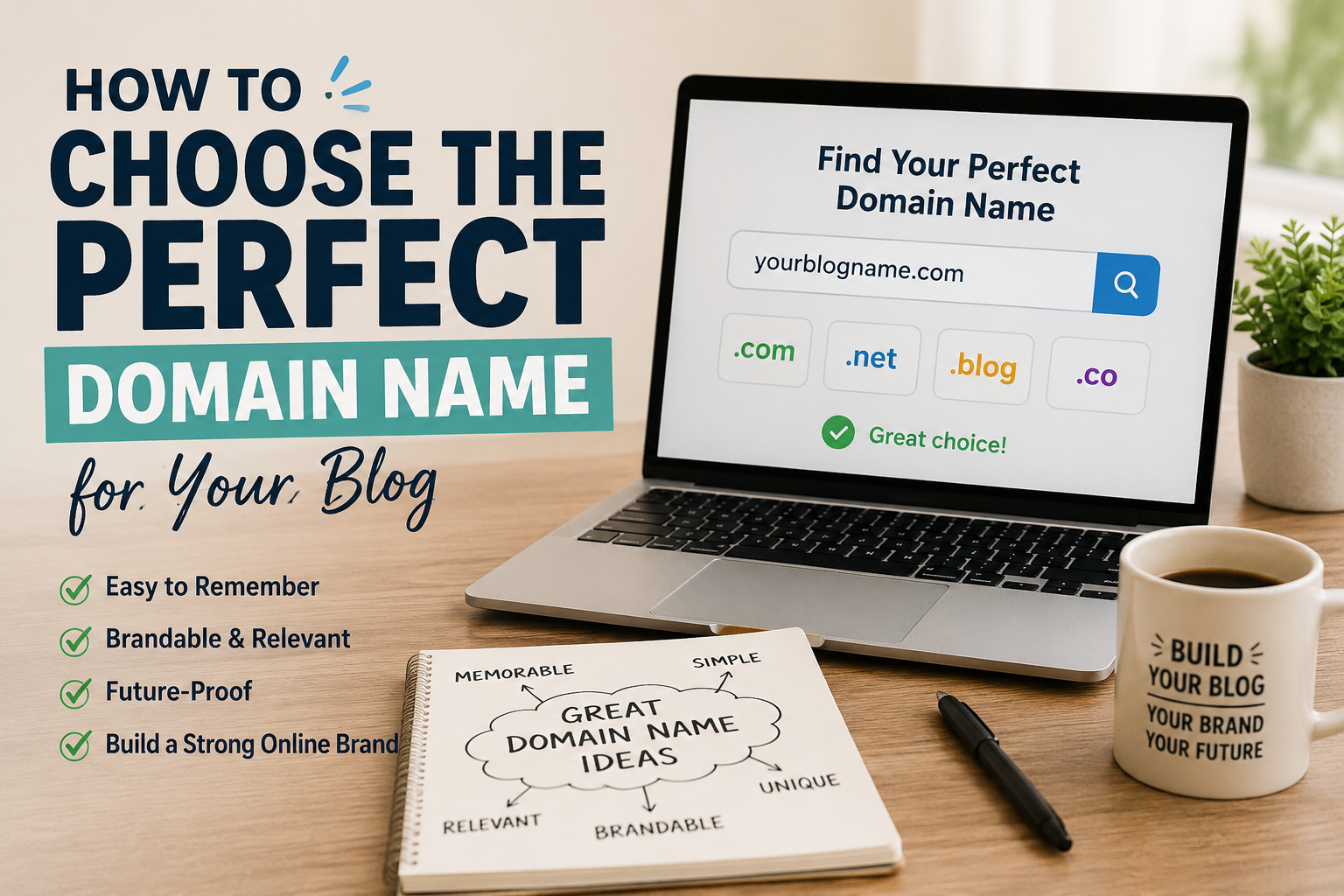
Your domain name is more than just your blog’s web address.
It shapes your brand, builds credibility, and helps readers remember and find your site.
The best blog domain names are simple, memorable, easy to spell, and flexible enough to grow with your content.
Before registering one, you’ll want to consider your niche, audience, domain extension, availability, and long-term brand potential.
Why Your Blog Domain Name Matters
Your domain name is often one of the first things people notice about your blog.
A clear, memorable name can make your blog feel trustworthy and give readers a reason to remember it.
Builds Your Blog’s Brand Identity
Your domain name becomes part of your blog’s identity and can influence how readers view your content.
A name that fits your topic, style, and audience makes it easier to build a consistent brand over time.
For example, a food blog with a name that clearly suggests recipes or cooking can immediately tell visitors what to expect.
Choose a name that you can comfortably use across your website, social media profiles, email addresses, and future products.
Makes Your Site Easier to Remember and Share
A short, simple domain name is easier for readers to remember after they discover your blog.
It is also easier to type, mention in conversation, and share with friends.
Avoid complicated spellings, long phrases, unnecessary numbers, and confusing combinations that could cause people to enter the wrong address.
Creates a Professional First Impression
Your domain name can affect how credible your blog feels before someone reads a single article.
A clean, relevant domain usually feels more established than one filled with random characters or awkward wording.
This does not mean you need an expensive or clever name.
You simply want a domain that looks intentional, fits your blog, and is easy for visitors to understand.
Can Support Long-Term SEO and Business Growth
Your domain name is not a shortcut to higher Google rankings, but choosing the right one can support your blog as it grows.
A relevant and memorable domain can make your brand easier to recognize when people see it in search results, social media posts, or other websites.
It should also leave room for your blog to expand into new topics, products, services, or other ways of earning money.
Think beyond what you plan to publish today and choose a domain name you will still be happy with several years from now.
What Makes a Good Blog Domain Name?
Keep It Short and Simple
Short domain names are usually easier to remember, type, and share.
Try to avoid long phrases that contain several words or make your web address difficult to read.
For example, easyhomecooking.com is easier to remember than thebestandeasyhomecookingrecipesonline.com.
A simple name also gives you more flexibility when people mention your blog or type the address on a phone.
Make It Easy to Spell
If readers cannot spell your domain name after hearing it once, it may create unnecessary problems.
Avoid unusual spellings, complicated words, or replacing words with numbers simply to make a domain available.
Say the name out loud and ask yourself whether someone could type it correctly without seeing it written down.
This is a simple test that can help you catch confusing names before you register one.
Make It Easy to Pronounce
A good domain name should sound natural when you say it.
If you have to explain how to pronounce or spell your blog name every time you mention it, consider choosing something simpler.
This matters when people recommend your blog in conversations, podcasts, videos, or other forms of content.
Choose a Memorable Name
Your domain name should give people something they can easily remember after visiting your blog.
A distinctive word, simple phrase, or creative combination can help your blog stand out from similar websites.
Think about what makes your blog different and look for a name that reflects that quality without becoming complicated.
Before settling on a name, say it a few times and ask someone else what they remember about it a few minutes later.
Avoid Unnecessary Numbers and Hyphens
Numbers and hyphens can make a domain harder to communicate and remember.
For example, someone hearing bestcoffee4you.com may not know whether to type “4” or “four.”
Hyphens can create a similar problem because people may forget to include them when typing the address.
If you can choose a clean version without numbers or hyphens, that is usually the easier option.
Make It Relevant to Your Blog
Your domain name should have some connection to your blog, brand, or the audience you want to reach.
A relevant name can help visitors understand what your website offers before they even open a page.
For example, a blog about home gardening could use a name related to gardens, plants, growing, or gardening tips.
However, do not make your domain so specific that it prevents you from covering related topics later.
Choose a name that fits your current focus while leaving enough room for your blog to grow.
How to Choose a Domain Name for Your Blog
Define Your Blog’s Niche
Start by getting clear about what your blog will cover.
Your niche helps you identify words, ideas, and themes that could work well in your domain name.
For example, a personal finance blog might focus on saving money, budgeting, investing, or making extra income.
You do not need to include your exact niche in the domain, but knowing your focus will make brainstorming much easier.
Identify Your Target Audience
Think about who you want to attract to your blog.
A domain name aimed at beginner gardeners may sound different from one designed for professional landscapers.
Consider the words your audience uses and the type of name they would find clear, trustworthy, and memorable.
When your domain feels familiar to your target readers, it can make your blog easier to connect with.
Brainstorm Relevant Keywords and Ideas
Write down words connected to your niche, audience, topics, and brand.
Do not worry about finding the perfect domain immediately.
Instead, create a large list and combine different words until you find names that sound natural.
For example, a travel blog could explore words such as “journey,” “roam,” “trip,” “routes,” “explore,” and “travel.”
Keywords can help communicate what your blog is about, but avoid forcing keywords into the name simply for SEO.
Consider Brandable Names
A brandable domain name feels distinctive rather than looking like a list of keywords.
It can be based on a real word, a combination of words, your name, or a creative phrase.
For example, a name like “Daily Roamer” could work for a travel blog without limiting the site to one specific destination.
Think about whether the name would look good on a website, social media profile, email address, or future product.
Check Domain Availability
Once you have several strong ideas, check whether the domains are available to register.
Do not stop after finding one unavailable name because a small change may produce an equally strong alternative.
Check the exact spelling carefully before purchasing anything.
Also look at the price, renewal cost, and whether the domain is being sold as a premium domain, which can cost much more than a standard registration.
Check Social Media Availability
Search for your potential blog name on the social platforms you expect to use.
Having a similar or matching username across your main platforms can make your brand easier for people to recognize.
You do not necessarily need every social handle to match perfectly.
However, avoid choosing a domain name that is already strongly associated with another business or creator.
Research Existing Trademarks
Before registering a domain, make sure the name does not conflict with an established trademark.
A domain being available does not automatically mean you are free to use the name as a brand.
Search for businesses using the same or a very similar name, particularly within your industry.
If you plan to build a serious business around the blog, consider getting professional legal advice when you are unsure about a potential trademark conflict.
Choose the Right Domain Extension
The domain extension is the part that appears after the name, such as .com, .org, or .net.
For most blogs, .com is a familiar and straightforward choice if a suitable name is available.
Other extensions can also work, especially when they fit your brand or target market.
If you are building a local blog, a country-specific extension may make sense for your audience.
Which Domain Extension Should You Choose?
.com
.com is the most familiar domain extension for many internet users.
It is a strong choice if you want your blog to appeal to a broad audience or eventually grow into a larger brand.
A good .com domain is worth considering even if it does not contain an exact keyword.
If the .com version of your preferred name is unavailable, do not force a long or confusing alternative just to get one.
.net
.net is another established domain extension that can work for blogs, websites, and online businesses.
It can be a practical alternative when the .com version of your preferred name is already taken.
However, some visitors may automatically type .com when trying to find your site.
Make sure the .net name is clear and does not closely resemble an existing .com brand.
.org
.org is commonly associated with organizations, communities, and nonprofit websites.
It can still be used for other types of websites, but visitors may expect a community-focused or mission-driven site when they see it.
For a typical personal or commercial blog, .com may feel more natural.
If your blog supports a community, cause, or organization, however, .org could be a good fit.
Niche and Country-Specific Extensions
There are many newer domain extensions designed around specific industries, interests, and locations.
For example, extensions such as .coffee, .travel, or .shop can help communicate what a website is about.
Country-specific extensions, such as .co.za for South Africa or .co.uk for the United Kingdom, can also make sense when your blog primarily serves a particular country.
These extensions can make a domain more distinctive, but check that your chosen extension is widely recognized by your target audience.
Should You Always Choose a .com Domain?
No, you do not have to choose .com.
A different extension can be perfectly suitable if it fits your blog, audience, and brand.
The most important thing is choosing a domain that is easy to remember, simple to type, and clearly connected to your blog.
If a great .com name is available at a normal registration price, it is often worth considering, but do not sacrifice a strong brand name just to use .com.
Common Domain Name Mistakes to Avoid
- Choosing a name that is too long: Long domain names are harder to remember, type, and share.
- Using confusing spelling: Unusual spellings can make it difficult for readers to find your blog.
- Adding unnecessary hyphens or numbers: These can make your domain harder to communicate and easier to mistype.
- Choosing a name that limits future growth: Avoid names that are so specific that they prevent you from covering related topics later.
- Using another brand’s trademark: Check for existing trademarks to avoid potential legal and branding problems.
- Selecting a domain that is difficult to pronounce: A complicated name can be harder to recommend through conversations, videos, or podcasts.
- Choosing a name solely for keywords: A natural, memorable brand name is usually more valuable than forcing keywords into your domain.
How to Generate Blog Domain Name Ideas
Coming up with a good blog domain name can feel difficult when every obvious name seems to be taken.
Instead of waiting for one perfect idea, create a list of options and narrow them down using a few simple tests.
Use Your Blog Topic or Niche
Start with words that naturally relate to your blog’s main topic.
Write down common terms, related concepts, problems your audience wants to solve, and words that describe your approach.
For a fitness blog, you might explore words such as “fit,” “strong,” “move,” “training,” “health,” or “active.”
You can then combine these ideas into names that clearly connect with your niche without sounding forced.
Combine Relevant Words
Combining two simple words can create a memorable and useful domain name.
Try pairing a topic-related word with something that describes your style, audience, location, or benefit.
For example, a travel blog could explore combinations such as “Roam Guide,” “Travel Nest,” or “Wander Notes.”
Say each combination out loud and remove anything that feels awkward or difficult to remember.
Use Your Own Name
Using your own name can be a great option if you plan to build a personal brand around your blog.
It gives you the freedom to cover different subjects without changing your domain if your interests evolve.
This approach can also work well for consultants, creators, writers, photographers, and other professionals who want their name closely connected to their work.
Before choosing this option, make sure your name is easy to spell and that readers are unlikely to confuse it with another person or brand.
Create a Brandable Word
You do not have to use words that directly describe your blog.
A unique combination, shortened word, or original name can become a strong brand if it is easy to pronounce, remember, and associate with your content.
Keep it simple enough that readers can spell it after hearing it.
Also check that the name does not already belong to an established company, product, or trademark.
Try a Domain Name Generator
A domain name generator can help when you have run out of ideas.
Enter a few words related to your niche, audience, or brand and use the suggestions as starting points.
You do not have to use the exact names it produces.
Often, the best value comes from seeing unexpected word combinations that spark a better idea of your own.
Ask Friends or Your Audience for Feedback
Once you have a shortlist, ask a few people what they think of each name.
Do not simply ask which one they like best.
Ask whether they can remember it, spell it correctly, understand what the blog might be about, and pronounce it without help.
If several people struggle with the same name, that is a useful warning sign.
Choose the domain that is clear and memorable rather than the one that only sounds clever to you.
How to Check if a Domain Name Is Available
- Search for the domain through a reputable registrar: Enter your preferred domain into a trusted domain registrar to see whether it is available and check its registration and renewal costs.
- Check social media handles: Search for the same or a similar name on the social platforms you plan to use so your branding can stay consistent.
- Search for existing businesses and websites using similar names: Make sure your chosen name is not already closely associated with another business, website, or creator.
- Verify trademark availability before purchasing: Check relevant trademark databases to reduce the risk of legal or branding conflicts later.
How Much Does a Blog Domain Name Cost?
A blog domain name typically costs around $10 to $30 per year for a standard domain, although prices vary depending on the registrar and domain extension.
Your first-year registration price may also be lower than the regular renewal price, so always check what you will pay in future years before choosing a domain.
Renewal fees are the amount you pay each year to keep your domain registered, and they can vary significantly between extensions and registrars.
Some domain names are classified as premium domains because they are short, memorable, or highly desirable, and these can cost hundreds or even thousands of dollars.
A premium domain is not necessary for starting a successful blog, so there is usually no reason to spend a large amount when a strong, affordable alternative is available.
The cheapest domain name is not always the best choice if it is difficult to spell, hard to remember, or poorly suited to your brand.
When choosing a blog domain name, consider the total cost, renewal price, ease of use, and long-term value rather than simply choosing the lowest introductory price.
Should You Use Your Name or a Brand Name for Your Blog?
When to Use Your Own Name
Using your own name can be a good choice when your blog is closely connected to your experience, opinions, skills, or personality.
It works particularly well for personal blogs, consultants, writers, creators, coaches, and professionals who want readers to associate the content directly with them.
A personal domain also gives you room to change topics without needing to rebrand your website.
For example, if you start by writing about freelance writing and later add content about business or productivity, your own name will still fit.
When to Use a Brand Name
A brand name can be a better choice when you want the blog to focus on a specific niche, topic, product, or audience rather than on you personally.
It can also make sense if you plan to work with other writers or eventually build a larger website or business around the blog.
A strong brand name can communicate what your website is about while giving you an identity that exists independently of one person.
Just make sure the name is broad enough to accommodate future changes if you expect your blog to expand.
Pros and Cons of Each Approach
Using your own name gives you more personal flexibility and can make it easier to build a recognizable personal brand, but it may be less descriptive of your blog’s topic.
A brand name can make your niche clearer and create a separate identity for the website, but changing direction later may be harder if the name is too specific.
Before choosing, consider whether you want readers to follow you or primarily follow the brand and content you create.
If you are unsure, choose the option that gives you more freedom to grow without requiring a domain change later.
Tips for Choosing a Domain Name That Can Grow With Your Blog
- Avoid overly narrow names: Choose a domain that gives you room to cover related topics instead of locking you into one small subject.
- Think beyond your first few blog topics: Consider what you might write about in the next few years, not just what you plan to publish today.
- Consider future products, services, or monetization: Pick a name that could still work if you later sell products, offer services, create courses, or add affiliate content.
- Choose a name that can become a recognizable brand: Look for something distinctive, easy to remember, and suitable for your website, social media, email, and future business activities.
Final Checklist Before Registering Your Domain
- Short and easy to remember: Make sure readers can recall your domain without much effort.
- Easy to spell and pronounce: Choose a name people can type and say correctly the first time.
- Relevant to your niche or brand: Make sure the name gives visitors some idea of what your blog represents.
- Free from confusing numbers and hyphens: Avoid elements that could make your domain difficult to communicate or type.
- Available across important social platforms: Check whether matching or similar usernames are available on the platforms you plan to use.
- Does not conflict with existing trademarks: Search for existing trademarks and businesses using the same or a very similar name.
- Suitable for your blog’s future growth: Choose a name that will still make sense if your content, audience, or business expands.
- Uses an appropriate domain extension: Select an extension that fits your brand, audience, and long-term goals.
Final Thoughts
The best domain name for your blog is simple, memorable, brandable, and flexible enough to grow with you.
Before registering, check its availability, social handles, and potential trademark conflicts.
Choose a name you can confidently build your blog and brand around for years to come.
FAQs
What makes a good domain name for a blog?
A good blog domain name is short, memorable, easy to spell, relevant to your brand, and simple to share.
Should my blog domain name include keywords?
Keywords can show what your blog is about, but a memorable and brandable domain is usually more valuable than forcing keywords into the name.
Is .com the best domain extension for a blog?
.com is familiar and widely recognized, but other extensions can work well if they suit your brand and audience.
Should I use my name as my blog domain?
Using your name works well for personal brands, while a separate brand name may be better for niche or business-focused blogs.
Can I change my blog domain name later?
Yes, but changing domains can affect your branding, links, and SEO, so it is best to choose carefully from the beginning.
How long should a blog domain name be?
Keep your domain as short as possible while making it clear, memorable, easy to spell, and easy to type.





Hi, I’m Daniel Cacheton. I specialize in WordPress performance optimization and have spent 7+ years improving site speed, Core Web Vitals, and overall user experience. I share practical, no-fluff guides based on real testing to help you build faster WordPress websites.